








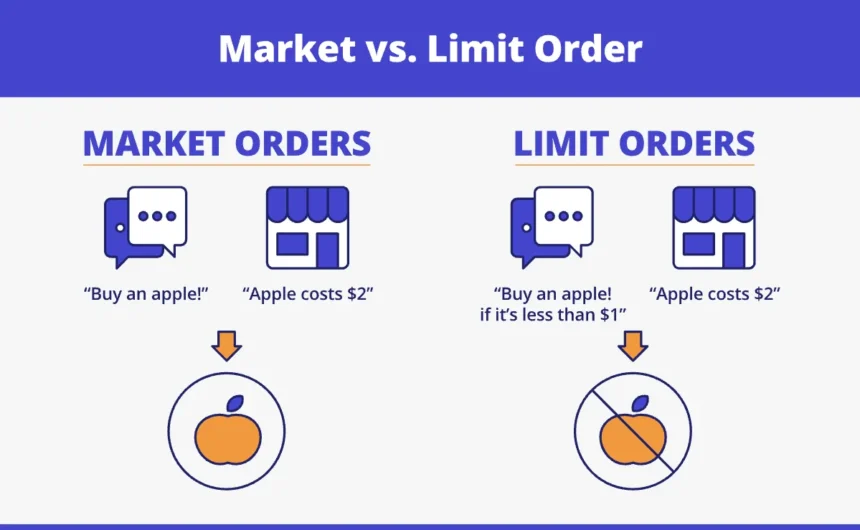
When placing a trade in stocks, forex, crypto, or any financial market, one simple decision can shape your results more than you think: should you use a market order or a limit order?
- What is a Market Order?
- What is a Limit Order?
- Market Order vs Limit Order: The Core Difference
- When to Use a Market Order
- When to Use a Limit Order
- Real World Scenario Comparison
- Understanding Slippage and Execution Quality
- Partial Fills and Liquidity Considerations
- Time in Force: An Often Overlooked Detail
- Strategic Use Cases for Different Trading Styles
- Common Mistakes When Choosing Between Limit and Market Orders
- Combining Market and Limit Orders for Better Execution
- How to Decide: A Practical Framework
- Final Thoughts: Control vs Certainty
Many traders focus heavily on strategy, charts, and indicators. Yet the type of order they use to enter or exit a position often gets less attention. That is a mistake. Order type directly affects your execution price, speed, slippage, and overall risk management.
If you have ever asked yourself, “Which order type should I use?” this guide is for you. We will clearly define market and limit orders, compare their pros and cons, and walk through real examples so you can decide what fits your trading style and goals.
Let us start with the basics.
What is a Market Order?
A market order is the simplest type of trade. When you place a market order, you are instructing your broker to buy or sell a security immediately at the best available price in the market.
You are prioritizing speed over price.
If you submit a market buy order, the system matches you with the lowest available selling price. If you submit a market sell order, it matches you with the highest available buying price.
This happens almost instantly in liquid markets.
Example of a Market Order
Imagine a stock is currently trading at:
- Bid: 100
- Ask: 100.20
If you place a market buy order, you will most likely purchase at 100.20, the current asking price. If you place a market sell order, you will likely sell at 100, the current bid.
However, if the market is moving quickly, your execution price may differ slightly from what you saw on the screen. This difference is called slippage.
Pros of Market Orders
- Immediate execution
Market orders are almost always filled instantly in liquid markets. This is useful when timing is critical. - Simplicity
They are easy to use and require no price calculation. You just click buy or sell. - Essential in fast-moving markets
If the price is moving quickly and you must enter or exit immediately, a market order ensures you do not miss the trade.
Cons of Market Orders
- No control over final price
You do not control the exact price you get. You accept whatever is available. - Slippage risk
In volatile markets, the execution price may differ significantly from the last quoted price. - Higher cost in illiquid markets
If there are few buyers or sellers, your order could be filled at multiple price levels, increasing your effective cost.
Market orders are powerful when speed matters more than precision. But they are not always the best choice.
| Aspect | Market Order Pros | Market Order Cons | Limit Order Pros | Limit Order Cons |
|---|---|---|---|---|
| Execution | Guaranteed & instant | No price control | Price guaranteed (or better) | No execution guarantee |
| Slippage | – | High risk | Low risk | – |
| Fees | – | Often taker fees | Often maker rebates | – |
| Control | Simple & fast | Emotional risk (chasing) | Precise & disciplined | Requires waiting/planning |
What is a Limit Order?
A limit order allows you to set the exact price at which you are willing to buy or sell a security.
You are prioritizing price over speed.
If you place a buy limit order, you specify the maximum price you are willing to pay. The trade will only execute at that price or lower.
If you place a sell limit order, you set the minimum price you are willing to accept. The trade will only execute at that price or higher.
Example of a Limit Order
Using the same example:
- Bid: 100
- Ask: 100.20
Suppose you want to buy the stock, but you feel 100.20 is too high. You place a buy limit order at 99.80.
Your order will only execute if the price drops to 99.80 or lower. If the price never reaches that level, your order remains unfilled.
You gain price control, but you lose certainty of execution.
Pros of Limit Orders
- Full price control
You decide the exact price at which you are willing to trade. - Protection from slippage
Your trade will not execute at a worse price than your limit. - Better cost management
Especially useful for large positions or less liquid assets.
Cons of Limit Orders
- No guarantee of execution
If the market never reaches your price, the trade will not happen. - Missed opportunities
In fast rallies or sharp drops, the price may move away before your order is filled. - Requires more planning
You need to determine appropriate price levels.
Limit orders are ideal when discipline and price precision matter more than immediate entry.
Market Order vs Limit Order: The Core Difference

At its core, the difference between market and limit orders comes down to one question:
Do you care more about getting into the trade now or getting in at a specific price?
Market order = guaranteed execution, uncertain price.
Limit order = guaranteed price, uncertain execution.
Both serve different purposes. Neither is universally better. The right choice depends on context.
| Feature | Limit Order | Market Order |
|---|---|---|
| Definition | Buy/sell at a specific price or better | Buy/sell immediately at best available price |
| Price Control | High (you set the exact price) | None (accepts current market price) |
| Execution Guarantee | Price guaranteed, execution not guaranteed | Execution guaranteed, price not guaranteed |
| Slippage Risk | Low (protected by limit) | High (especially in volatile/low-liquidity) |
| Speed | Slower (wait for price to hit) | Instant (fills right away) |
| Best For | Precise entries/exits, swing/long-term | Urgent trades, high-liquidity assets |
| Fees (Typical) | Often maker (rebate possible) | Often taker (higher fee) |
| Risk in Volatility | May miss trade entirely | May fill at worse price due to slippage |
When to Use a Market Order
Market orders are generally better in the following situations:
1. High Liquidity Assets
In highly liquid markets such as major stocks, large ETFs, or major forex pairs, the bid-ask spread is usually tight. Slippage tends to be minimal. In such cases, market orders are often efficient and cost-effective.
2. Breaking News or Fast Moves
If important news breaks and the price is moving quickly, waiting for a limit order to fill may mean missing the move entirely. Traders who focus on momentum or breakout strategies often use market orders to ensure immediate participation.
3. Exiting Risky Positions
If a trade is going against you and you want to exit immediately, a market order may be safer than waiting for a specific price. Speed can reduce further losses.
4. Small Position Sizes
For smaller trades in liquid markets, the price difference between market and limit execution is often negligible.
In short, use a market order when execution certainty is more important than fine price optimization.
| Scenario / Trading Style | Recommended Order | Reason / Example |
|---|---|---|
| Need immediate entry/exit (breakout, news) | Market Order | Speed over price; e.g., buy BTC on sudden pump |
| Entering at support/resistance level | Limit Order | Price control; e.g., buy ETH at $2,500 dip |
| High volatility (avoid bad fills) | Limit Order | Prevents slippage; e.g., sell during flash crash |
| High liquidity asset, small position | Market Order | Minimal slippage risk |
| Large order in thin market | Limit Order | Avoid partial fills at bad prices |
| Day trading (quick moves) | Mix (market for exits, limit for entries) | Balance speed & precision |
| Long-term investing / DCA | Limit Order | Better average entry price |
When to Use a Limit Order
Limit orders shine in situations where price discipline is essential.
1. Entering at Key Support or Resistance
If your strategy depends on buying near support or selling near resistance, a limit order allows you to place your trade exactly at that technical level.
2. Thin or Volatile Markets
In low liquidity environments, market orders can cause significant slippage. A limit order protects you from paying much more than expected.
3. Pre-Planned Swing Trades
If you plan trades and identify precise entry levels, limit orders align well with structured strategies.
4. Large Orders
For larger position sizes, limit orders help control the average execution price and prevent adverse fills.
In essence, limit orders are about patience and control.
| Time in Force (TIF) | Meaning | Best Use Case | Expires If… |
|---|---|---|---|
| Day (DAY) | Valid until end of trading day | Day trading | End of session |
| Good ‘Til Canceled (GTC) | Stays active until filled or canceled | Swing/long-term setups | Manually canceled |
| Immediate or Cancel (IOC) | Fills what it can immediately, cancels rest | Large orders in thin markets | Partial fill or none |
| Fill or Kill (FOK) | Must fill entirely or cancel completely | All-or-nothing large trades | Not fully filled instantly |
Real World Scenario Comparison
Consider two traders watching the same stock trading at 50.
Trader A believes a breakout above 50.50 will trigger a strong upward move. He places a market order as soon as the price hits 50.50 to ensure he gets in.
Trader B believes the stock is slightly overvalued and wants to buy on a pullback to 49.80. She places a buy limit order at 49.80.
If the stock rallies straight to 55 without retracing, Trader A participates in the move. Trader B misses the trade.
If the stock drops to 49.80 before moving up, Trader B gets a better entry. Trader A either buys higher or misses the ideal entry.
Same market. Different approach. Different outcomes.
Beyond the basic comparison, understanding how these order types behave in real trading conditions will help you make smarter decisions. Let us go deeper into execution mechanics, advanced considerations, and common mistakes traders make when choosing between limit and market orders.
Understanding Slippage and Execution Quality
Slippage is the difference between the expected price of a trade and the actual execution price. It occurs mainly with market orders, especially during high volatility or low liquidity.
For example, you see a stock trading at 200 and place a market buy order. By the time your order reaches the exchange, sellers at 200 may already be filled. Your order might execute at 200.30 or even 201 if the market is moving quickly.
This does not mean market orders are bad. It simply means you are accepting execution at the best available price, not necessarily the last quoted price.
Limit orders, on the other hand, protect you from negative slippage. If you set a buy limit at 199.50, you will not pay more than that. However, if the price never touches 199.50, you remain unfilled.
Professional traders often think in terms of trade-offs. With market orders, the risk is price uncertainty. With limit orders, the risk is opportunity cost.
Partial Fills and Liquidity Considerations
Another important factor is how orders get filled.
In highly liquid markets, both market and limit orders are usually filled in full and almost instantly. However, in thin markets, large orders may be partially filled.
Suppose you place a limit buy order for 5,000 shares at 30. If only 2,000 shares are available at that price, you receive a partial fill. The remaining 3,000 shares stay pending until more sellers appear at 30.
Market orders can also experience partial fills across multiple price levels. If you submit a large market buy order and there are not enough sellers at the current ask, your broker may fill portions of your order at progressively higher prices. This increases your average entry cost.
This is why liquidity matters when choosing an order type. In large-cap stocks or major forex pairs, liquidity is deep, and spreads are tight. In small-cap stocks, exotic currency pairs, or low-volume crypto tokens, price gaps between levels can be wider.
If you are trading illiquid instruments, limit orders often provide better cost control.
Time in Force: An Often Overlooked Detail
When placing limit orders, you usually choose how long the order remains active. This is known as time in force.
Common options include:
Day order:
The order expires at the end of the trading day if not filled.
Good till canceled:
The order stays active until executed or manually canceled.
Immediate or cancel:
The order must execute immediately. Any unfilled portion is canceled.
Fill or kill:
The order must be filled entirely and immediately, or it is canceled.
Time in force does not change whether an order is a limit or market, but it affects how your strategy plays out. For example, swing traders often use good till canceled limit orders at predefined entry levels. Day traders may prefer day orders to avoid unexpected overnight fills.
Being intentional about time in force can prevent unintended trades.
Strategic Use Cases for Different Trading Styles
Different trading styles favor different order types.
Day Trading
Day traders often prioritize speed. In fast intraday moves, a delay of seconds can change profitability. Market orders are common for quick entries and exits, especially in high-volume stocks.
However, experienced day traders also use limit orders to reduce transaction costs. Some exchanges even provide fee incentives for adding liquidity through limit orders.
Swing Trading
Swing traders typically plan entries around support, resistance, or retracement levels. Limit orders align well with this structured approach. They allow disciplined entries without chasing price.
At the same time, if a breakout confirmation is required, a market order may be used once a key level is breached.
Long Term Investing
Investors building positions over time often prefer limit orders to avoid overpaying. If the price fluctuates daily, placing limit orders slightly below current levels can improve the average entry price.
That said, for broad index funds or highly liquid blue chip stocks, many long-term investors simply use market orders due to minimal spreads and simplicity.
The key is matching order type to strategy, not copying what others do.
Common Mistakes When Choosing Between Limit and Market Orders
Understanding what not to do is just as important.
1. Using Market Orders in Extremely Volatile Conditions
During earnings announcements or major economic releases, the price can jump significantly in seconds. A market order in such moments may execute far from the displayed price.
If you need price control during major news events, limit orders provide protection.
2. Setting Unrealistic Limit Prices
Some traders set limit orders far below the current market hoping for a sudden dip. While occasional flash crashes do occur, unrealistic pricing often leads to missed trades.
A limit order should be based on analysis, not wishful thinking.
3. Ignoring the Bid Ask Spread
If the spread is wide, placing a market order means you immediately pay that spread. In contrast, placing a limit order near the bid when buying can reduce cost.
Always observe the spread before deciding.
4. Emotional Order Placement
Fear and greed often influence order choice. For example, chasing a rally with repeated market orders can lead to poor entries. Conversely, stubbornly waiting for a perfect limit price can cause repeated missed opportunities.
A predefined plan reduces emotional decisions.
Combining Market and Limit Orders for Better Execution
Experienced traders rarely think in black and white terms. They combine order types strategically.
For example:
Entering with a limit order at support
Using a market order to exit quickly if the stop loss is triggered
Scaling into positions with multiple staggered limit orders
Using a market order to ensure participation after confirmation
This blended approach allows both precision and flexibility.
You can also use stop limit and stop market orders for risk management. While they are beyond the core scope of this article, they further illustrate that execution tools are part of strategy, not separate from it.
How to Decide: A Practical Framework
If you are still wondering which order type to use, ask yourself these five questions:
- How urgent is this trade?
If timing is critical, consider a market order. - How liquid is the asset?
High liquidity reduces market order risk. - How sensitive am I to entry price?
If a few cents matter significantly, use a limit order. - What is my strategy?
Breakout strategies often favor market orders. Pullback strategies often favor limit orders. - Am I trading emotionally or following a plan?
If the decision feels rushed, pause and reassess.
This simple framework brings clarity.
Final Thoughts: Control vs Certainty
Choosing between a limit order and a market order is not about right or wrong. It is about priorities. Market orders give you certainty of execution. You get in or out quickly. This is valuable in fast markets and high conviction moments.
Limit orders give you certainty of price. You protect yourself from overpaying or underselling. This is valuable in disciplined, price-sensitive strategies.
Every trader eventually learns that execution quality directly affects profitability. Two traders with the same strategy can have different outcomes purely because of how they enter and exit trades.
The smartest approach is not to blindly favor one order type. It is to understand how each works, recognize the trade-offs, and align your choice with your goals, time horizon, and risk tolerance.
When used thoughtfully, both limit and market orders are powerful tools. Mastering them may not feel exciting, but it quietly improves consistency and control over time.
In trading, small edges compound. Choosing the right order type is one of those small edges that makes a big difference.
Also read: How to Withdraw from Crypto Exchanges Safely and Securely