




If you have spent any time in crypto, you have likely faced a simple but important question: Should you use MetaMask or a hardware wallet? It sounds straightforward, but the answer depends on how you use crypto, how much you hold, and how seriously you take security.
- Understanding MetaMask
- What Is a Hardware Wallet?
- Security Comparison
- Custody and Control of Funds
- Daily Usage and Convenience
- Best Use Cases for MetaMask
- Best Use Cases for Hardware Wallets
- The Hybrid Setup Most Experts Use
- Cost Considerations
- Common Security Mistakes Users Make
- Custody Philosophy and Personal Responsibility
- Regulatory and Privacy Considerations
- Comparing Real World Risk
- Which Should You Choose?
- Final Thoughts
MetaMask is often the first wallet people encounter. It is easy to install, works directly in your browser or phone, and connects smoothly to almost every decentralized application. Hardware wallets, on the other hand, are usually recommended later, once users become more serious or more cautious. They promise stronger security, but they also come with extra cost and responsibility.
This article compares MetaMask and hardware wallets across three key areas: security, custody, and real-world use cases. The goal is not to declare a single winner, but to help you choose the right setup for your needs. By the end, you should clearly understand what each option offers, where each one falls short, and how experienced users often combine both.
Understanding MetaMask
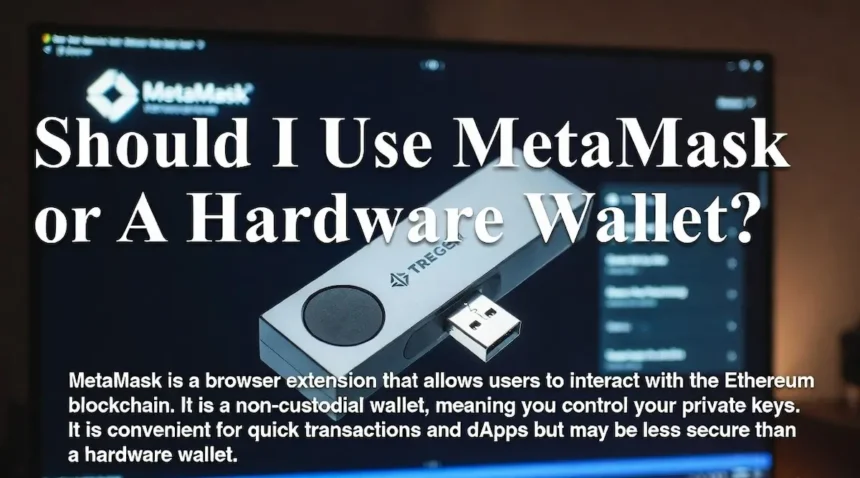
MetaMask is a non-custodial software wallet. This means you control your private keys, not an exchange or third party. It operates as a browser extension and mobile app, primarily designed for Ethereum and compatible networks like Polygon, Arbitrum, and BNB Chain.
When you create a MetaMask wallet, you are given a seed phrase. This phrase is the master key to your funds. Anyone who has it can access your assets. MetaMask itself does not store this phrase on its servers. It is encrypted and stored locally on your device.
One of MetaMask’s biggest strengths is accessibility. Within minutes, a new user can install it, fund it, and start interacting with decentralized finance platforms, NFT marketplaces, and Web3 games. It acts as a bridge between you and the blockchain.
However, convenience always comes with trade-offs, especially when security is involved.
What Is a Hardware Wallet?
A hardware wallet is a physical device designed to store private keys offline. Popular examples include devices made by Ledger and Trezor. Unlike software wallets, hardware wallets keep your private keys isolated from your computer or phone.
When you sign a transaction using a hardware wallet, the transaction details are sent to the device. You physically confirm the transaction by pressing buttons on the device. The private key never leaves the hardware wallet, even if your computer is compromised.
This design significantly reduces the risk of hacking, malware, or phishing attacks. For this reason, hardware wallets are often described as cold storage.
That said, hardware wallets are not completely risk-free. They require careful setup, secure storage of the recovery phrase, and disciplined usage. Losing the device or the recovery phrase can result in permanent loss of funds.
Security Comparison
Security is the main reason people consider switching from MetaMask to a hardware wallet.
MetaMask is as secure as the device it runs on. If your computer or phone is infected with malware, keyloggers, or malicious browser extensions, your wallet can be compromised. Phishing attacks are especially common. Fake websites can trick users into approving transactions or revealing their seed phrase.
MetaMask does include security features such as password protection, encrypted storage, and transaction previews. But ultimately, it remains a hot wallet. It is connected to the internet and exposed to everyday browsing risks.
Hardware wallets dramatically reduce these risks. Because private keys stay offline, attackers cannot steal them remotely. Even if your computer is fully compromised, the attacker cannot move your funds without physical access to the hardware wallet.
However, hardware wallets do not protect against every mistake. Users can still be tricked into approving malicious transactions if they do not carefully verify transaction details on the device screen. Security improves, but responsibility does not disappear.
Custody and Control of Funds
Both MetaMask and hardware wallets are non-custodial. This is an important distinction from centralized exchanges.
With MetaMask, you are fully responsible for your seed phrase. MetaMask cannot reset your password or recover your wallet if you lose it. This gives you independence, but also full accountability.
Hardware wallets operate on the same principle. The recovery phrase is generated during setup and must be stored securely. The difference is psychological as much as technical. Because hardware wallets feel more serious, users often treat their recovery phrase with greater care.
In practice, both options give you full custody. The difference lies in how exposed your keys are during everyday use.
Daily Usage and Convenience
MetaMask excels in convenience. It is fast, familiar, and deeply integrated with the Web3 ecosystem. You can swap tokens, stake assets, mint NFTs, and interact with smart contracts in seconds. For active users, traders, and DeFi participants, this speed matters.
Hardware wallets introduce friction. You must connect the device, unlock it, and physically approve each transaction. For frequent interactions, this can feel slow and annoying. On mobile, usage can be even more cumbersome.
Because of this, many experienced users do not treat this as an either-or decision. Instead, they use MetaMask connected to a hardware wallet. In this setup, MetaMask acts as the interface, while the hardware wallet handles key storage and transaction signing.
This hybrid approach offers the best of both worlds, though it still requires discipline and understanding.
Best Use Cases for MetaMask
MetaMask is ideal for beginners who are learning how wallets work and exploring small amounts of crypto. It is also suitable for users who interact daily with decentralized applications and need speed and flexibility.
It works well for low to medium-value wallets where convenience matters more than maximum security. Developers, NFT traders, and DeFi users often rely on MetaMask for operational wallets rather than long-term storage.
However, it should not be treated like a vault. Keeping large, long-term holdings in MetaMask alone increases exposure to unnecessary risk.
Best Use Cases for Hardware Wallets
Hardware wallets are best suited for long-term holders, high-value portfolios, and users who prioritize capital preservation over convenience. If you are treating crypto as an investment rather than a daily tool, a hardware wallet is usually the smarter choice.
They are ideal for storing assets that you do not plan to move frequently. Bitcoin held for years, Ethereum reserved for long-term staking, or large balances accumulated over time, all belong in cold storage. The reduced exposure to online threats makes hardware wallets particularly attractive for these scenarios.
Institutional users, high net worth individuals, and crypto professionals almost universally rely on hardware wallets for treasury management. Even among retail users, anyone holding more than they can afford to lose should strongly consider one.
That said, hardware wallets are not designed for speed. If your workflow involves constant approvals, frequent swaps, or experimental protocols, relying solely on a hardware wallet can become frustrating.
The Hybrid Setup Most Experts Use
One of the most common misconceptions is that users must choose between MetaMask and a hardware wallet. In reality, many experienced users combine both.
In this setup, MetaMask acts as the interface while the hardware wallet stores the private keys. Transactions are initiated through MetaMask but must be physically approved on the hardware device. This means the keys never touch the internet, while the user still benefits from MetaMask’s compatibility with decentralized applications.
This approach significantly improves security without sacrificing usability. It also reduces the risk of phishing attacks because malicious approvals cannot be completed without access to the hardware device.
For many users, this hybrid setup represents the best possible balance between safety and convenience. It does require a deeper understanding of wallet connections and transaction flows, but the learning curve is manageable.
Cost Considerations
MetaMask is free. This makes it accessible to anyone, regardless of budget. For beginners, this matters. It allows experimentation without upfront cost.
Hardware wallets require an initial purchase. Prices typically range from modest to moderately expensive, depending on the model and features. While this cost may seem high at first, it should be viewed in context. Spending a small amount to protect assets worth significantly more is a reasonable trade-off.
However, users with very small holdings may find the cost unjustified. If your portfolio is minimal, focusing on learning good security habits with a software wallet can be sufficient.
It is also important to buy hardware wallets only from official sources. Secondhand or tampered devices introduce serious risks.
Common Security Mistakes Users Make
Regardless of the wallet type, user behavior remains the weakest link.
With MetaMask, the most common mistake is revealing the seed phrase. No legitimate service will ever ask for it. Phishing websites and fake support accounts exploit this lack of awareness.
Another frequent issue is blind transaction approval. Many users click confirm without reading transaction details, exposing themselves to malicious smart contracts.
Hardware wallet users are not immune either. Losing the recovery phrase, storing it digitally, or failing to verify transaction details on the device screen can negate many of the security benefits.
Security tools work best when paired with caution, patience, and basic understanding.
Custody Philosophy and Personal Responsibility
Both MetaMask and hardware wallets represent self-custody. This is one of crypto’s defining features and also one of its greatest challenges.
There is no password reset. No customer support can reverse a mistake. Ownership comes with finality.
For some users, this freedom is empowering. For others, it is intimidating. Understanding your comfort level with responsibility is crucial when choosing a wallet setup.
If you prefer convenience and are willing to accept some risk, MetaMask may be sufficient. If you value sovereignty and long-term security, a hardware wallet aligns better with that mindset.
Regulatory and Privacy Considerations
Self-custodial wallets offer greater privacy than centralized exchanges. Neither MetaMask nor hardware wallets require identity verification to function.
However, privacy depends on usage. Interacting with regulated onramps, centralized services, or tracked addresses can still compromise anonymity.
Hardware wallets do not inherently make transactions private, but they reduce reliance on third parties. For users concerned about surveillance or account freezes, self-custody provides an important layer of independence.
Comparing Real World Risk
In practice, most crypto losses occur due to phishing, social engineering, and user error, not technical failures.
MetaMask users face higher exposure simply because the wallet is always online. Hardware wallet users reduce attack surface but still face risks if they approve malicious transactions.
The question is not which option is perfectly safe. The real question is which risks you are willing to manage.
Which Should You Choose?
If you are new to crypto, exploring decentralized applications, or managing small balances, MetaMask is a practical starting point. It is easy to use, widely supported, and flexible.
If you are holding significant value, planning long-term, or concerned about security, a hardware wallet becomes essential.
For users who want both security and usability, connecting MetaMask to a hardware wallet is often the best solution.
There is no single correct answer. The right choice depends on your goals, habits, and tolerance for responsibility.
Final Thoughts
The decision between MetaMask and a hardware wallet reflects a broader question about how you approach crypto.
MetaMask represents accessibility, experimentation, and speed. Hardware wallets represent discipline, patience, and long-term thinking.
As the ecosystem matures, users increasingly move toward layered security rather than simple choices. Many start with MetaMask, graduate to hardware wallets, and eventually combine both into a thoughtful setup.
Crypto rewards those who take ownership seriously. Whatever option you choose, understanding how it works and respecting its risks matters more than the tool itself.
In the end, the safest wallet is not just the one you use, but the one you understand.
Also read: How to Use Limit vs Market Orders: Which Order Type Should You Choose?